Palancar Reef Marine Life: Fish, Sea Turtles & Reef Sharks
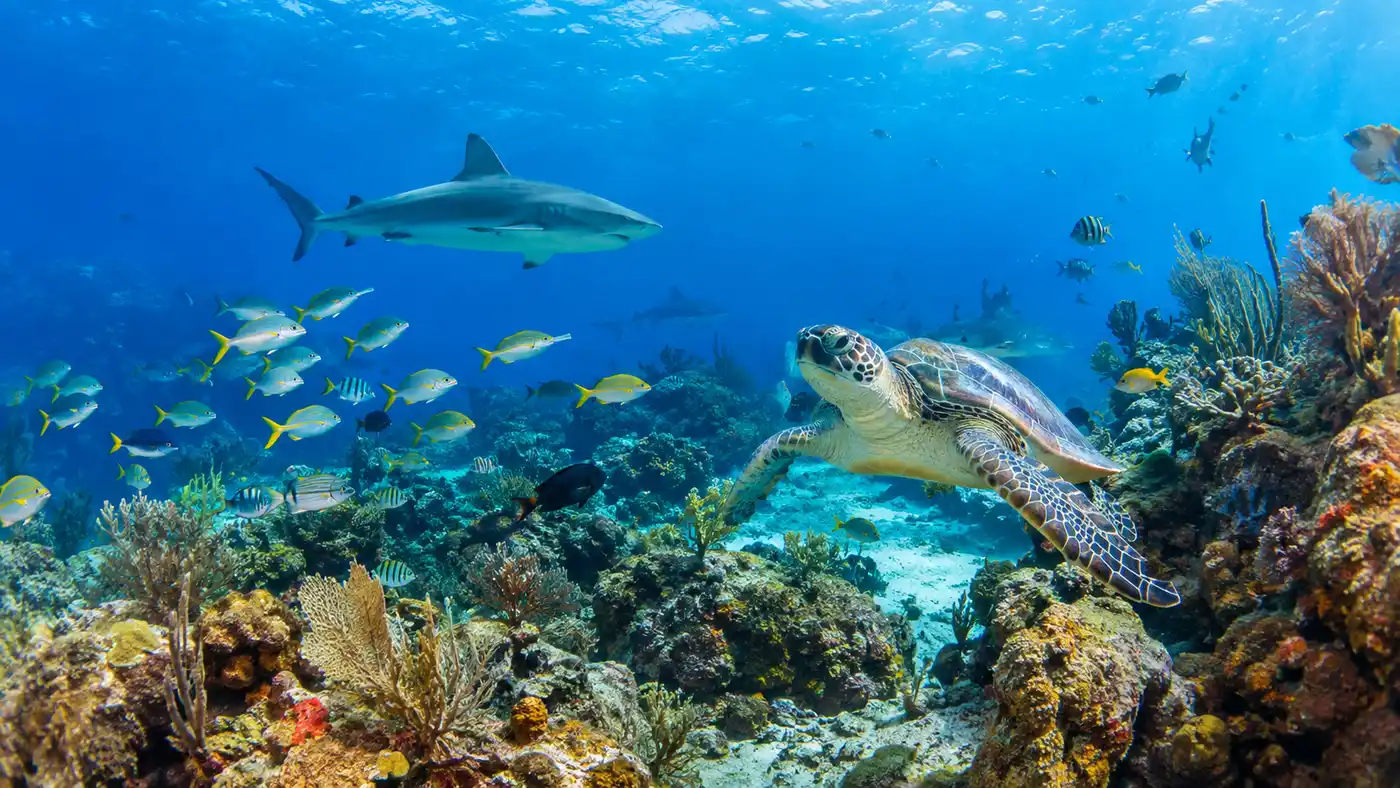
The bottom simply disappears about 60 feet down. You roll off the boat into 82-degree water, clear your mask, and suddenly you are floating beside coral pinnacles as tall as four-story apartment buildings. Encountering palancar reef animals along the southwestern edge of Cozumel feels less like swimming in a typical tropical bay and more like drifting through an underwater city. Everything is moving, feeding, or hiding in plain sight.
The Yucatan current does almost all the physical work here. It picks you up near the southern drop-offs and carries you gently northward across towering limestone buttresses, through shadowy swim-throughs, and over bright sand chutes where stingrays bury themselves up to their eyeballs. Because Palancar sits within the Arrecifes de Cozumel National Marine Park, the wildlife has enjoyed federal protection since 1996. Animals here generally do not bolt the second a human splashes into their territory. They have seen thousands of bubble-blowing divers, and they mostly just carry on with their morning routines.
Book your palancar reef experience:
Encounters with Palancar Reef Sharks and Open Water Predators
Most divers visit expecting high drama with teeth, and while you will definitely find apex predators here, they are far more relaxed than Hollywood movies suggest. Nurse sharks are by far the most frequent sight. You will usually find them tucked away under low limestone ledges during the day, dozing on the white sand. Sometimes you will see two or three piled together like overgrown, sandpaper-skinned puppies. They measure anywhere from five to nine feet long, breathing through spiracles behind their eyes while staying dead still.
Every now and then, you catch a silhouette out in the blue that quickens your pulse. Spotting a Caribbean reef shark on Palancar Reef is an experience that stays with you. These sleek predators cruise the deeper margins, typically between 70 and 110 feet, tracing the edges where the coral wall plunges toward the abyss. If you ever read an old forum post describing a Caribbean reef shark palancar reed encounter, they were probably confused by the spelling, but the sheer drop-off along the outer reef is indeed where these torpedo-shaped hunters patrol. They rarely approach divers closely. Instead, they glide along the boundary between bright sunlight and dark depths, checking for injured fish.
Blacktip sharks occasionally appear in the winter months, cutting briskly through the channels between coral heads before vanishing into the gloom. Hammerheads show up too, though seeing one is pure luck. Local divemasters who log 500 dives a year might only run into a solitary great hammerhead twice a season, usually out over the deep sand flats early in the morning.
Pro tip: Do not crane your neck only into dark crevices; glance out into the open blue every few minutes. Spotted eagle rays and cruising reef sharks often pass thirty yards behind divers who are completely preoccupied staring at a tiny crab.
Southern stingrays and spotted eagle rays round out the big-fish roster. Eagle rays are pure elegance in the water. With wingspans reaching up to eight feet, they ride the strong winter currents between November and March. They fly past in loose formations of four or five, their white-spotted backs gleaming against deep cobalt water. It looks completely effortless, while humans nearby burn through half their air tank just kicking against the surge.
Tracking Palancar Reef Sea Turtles Along the Wall
You have an exceptionally high chance of seeing turtles at Palancar. They graze on the sponges, rest on the ledges, and periodically head up to the surface for a lungful of Caribbean air. Understanding which species you are looking at comes down to shell patterns and head shape.
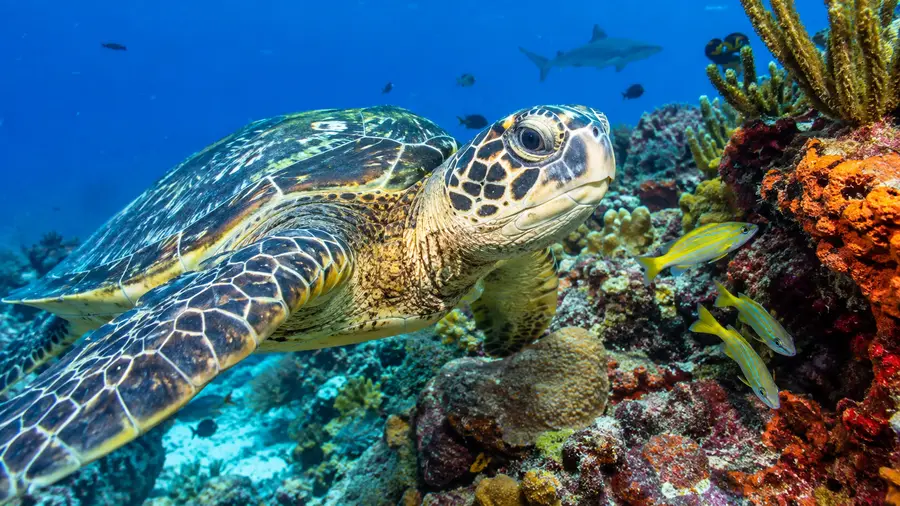
Hawksbill turtles reign supreme along the mid-depth coral formations. With their narrow, hawk-like beaks and overlapping shell scutes, they spend hours wedging their heads into deep crevices to tear away toxic sponges that would sicken other marine creatures. They are remarkably unbothered by snorkelers and divers. I once watched a three-foot hawksbill methodically strip a yellow tube sponge bare while six divers hovered five feet away; the turtle paused only to eyeball its audience before tearing off another mouthful.
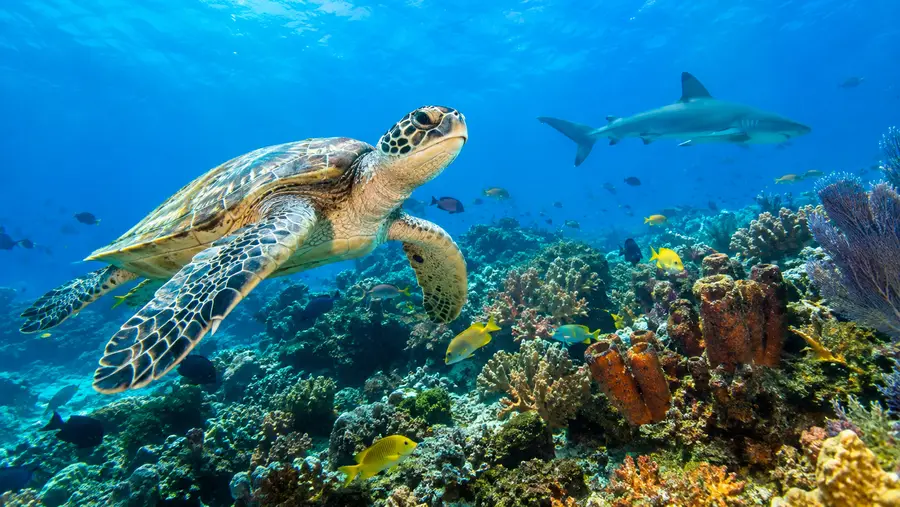
Green sea turtles tend to favor the shallower shelves, especially where the reef transitions into rolling seagrass beds. They are larger, smoother, and somewhat more timid than hawksbills. If you plan your route carefully or review a dedicated guide to diving Palancar Reef, you will notice that the shallower slopes of Palancar Gardens give you the best light for photographing greens as they lift off the seabed.
- Hawksbill turtle: Pointed raptor-like beak, jagged shell margins, commonly found chewing on sponges around 40 to 60 feet.
- Green sea turtle: Rounded snout, smooth shell borders, frequently spotted gliding across sunny upper flats near 25 feet.
- Loggerhead turtle: Massive blocky head, reddish-brown shell, much rarer here and usually seen cruising deep outer channels.
A giant loggerhead is unmistakable when one actually wanders past. Their heads look as wide as tree trunks, built with crushing jaw muscles designed to crack open conch shells and spiny lobsters. They look prehistoric, weathered, and slightly grumpy compared to the graceful greens.
Resident Palancar Reef Fish and Macro Oddities
Beyond the charismatic megafauna, the sheer density of everyday fish life turns every coral head into a noisy, bustling neighborhood. Parrotfish provide the ambient soundtrack. Drop your head near any boulder star coral and you can hear a distinct crunching sound echoing through the water. That is the sound of stoplight and queen parrotfish scraping algae off the rock with fused, beak-like teeth, eventually excreting the pulverized limestone as white sand.
Queen angelfish and French angelfish patrol the reef in bonded pairs. The French angelfish, with dark charcoal bodies tipped in golden flakes, show zero fear of humans and will happily swim right up to your dive mask to inspect their own reflection in the glass. Queen angelfish stay slightly more aloof, flashing brilliant turquoise, cobalt, and electric yellow scales as they slip through coral crevices.
Then there is the creature everyone comes to hunt for with dive lights: the splendid toadfish. This species lives in Cozumel and nowhere else on Earth. It spends daylight hours tucked deep under coral overhangs, hidden inside low limestone burrows. With bright canary-yellow fins, alternating dark stripes, and a wide whiskered chin, it looks like an ornate aquatic frog. You will usually hear their low, vibrating mating call - which sounds oddly like an electric boat horn buzzing through the water - long before your guide points out a pair of glowing eyes buried in a crack.
Note: Touching coral formations or bracing against ledges to snap photos of toadfish destroys fragile living polyps that take decades to grow back. Work on neutral buoyancy before attempting close-up photography here.
Moray eels are just as common. Green morays, which are actually dark blue animals coated in a layer of yellow mucus that makes them appear neon green, reach lengths of six feet and thicknesses resembling human thighs. You will find them anchored in dark pockets, rhythmically opening and closing their toothy jaws to push water through their gills. Spotted morays and tiny golden morays occupy the smaller nooks higher up on the reef structure.
Book your palancar reef experience:
The Dynamic Palancar Reef Ecosystem
Palancar is not one single, uniform wall. It is an expansive coral complex that stretches for roughly three miles, divided into distinct zones like Palancar Gardens, Palancar Horseshoe, Palancar Caves, and the Deep Wall. Each section supports distinct wildlife communities based on current exposure, depth, and sunlight penetration.
Massive mountainous star coral and giant brain corals form the foundational bedrock here. Growing alongside them are giant barrel sponges that measure six feet across. Some of these specimens have been filtering seawater on this ledge since the seventeenth century. When ocean currents sweep over the shelf, these sponges draw in thousands of gallons of water per hour, trapping microbes and expelling purified water out their central chimneys.
Because environmental pressures on Caribbean reefs have climbed over recent years, local authorities carefully enforce zoning and trail rules. If you are curious about current conservation efforts, park rules, and scheduled rest rotations, it is worth checking the rules and seasonal closures for Palancar before booking your boat trip. Keeping human impact contained is the only reason these massive coral heads still support such ridiculous quantities of life.
| Reef Zone | Depth Range | Signature Wildlife | Spotting Difficulty |
|---|---|---|---|
| Palancar Shallows | 15 - 35 feet | Green turtles, yellow stingrays, juvenile reef fish, barracudas | Easy (ideal for snorkelers) |
| Palancar Gardens | 35 - 75 feet | Hawksbill turtles, French angelfish, nurse sharks, green morays | Moderate (gentle current) |
| Palancar Horseshoe | 45 - 90 feet | Splendid toadfish, queen triggers, massive groupers, lobsters | Moderate (tight swim-throughs) |
| Palancar Caves & Wall | 60 - 120+ feet | Caribbean reef sharks, eagle rays, black groupers, jacks | Advanced (deep edge, swift drifts) |
Schools of horse-eye jacks and permit frequently congregate above the pinnacles in Palancar Caves. When the afternoon sun cuts down through the limestone tunnels, it illuminates hundreds of silver flanks wheeling in unison. Solitary great barracudas often hover motionless near the surface, watching the entire show with cold, calculating eyes. They look menacing with their lower jaws jutting forward to show needle-sharp teeth, but they are completely indifferent to swimmers passing below.
Tips for Maximizing Wildlife Sightings
Seeing the full spectrum of marine species requires adjusting how you move in the water. The drift takes care of your speed, so your main job is simply controlling your vertical position and keeping your eyes relaxed.
- Master your breathing: Heavy kick cycles burn oxygen and send loud vibrations through the water column, causing sharks and rays to veer away before you ever spot them.
- Carry a pocket dive light: Even on bright sunny days at 50 feet, red and yellow wavelengths are absorbed by seawater. A narrow light beam reveals splendid toadfish whiskers, hidden octopuses, and cleaner shrimp hiding in shadowy holes.
- Scan the sandy transitions: Yellow stingrays, peacock flounders, and jawfish make their homes right where the massive coral walls meet wide sand channels. Look for symmetrical bumps or breathing holes in the sediment.
- Book early morning boats: The earliest departure boats hit the water around 8:30 AM, reaching the reef before dozens of tour catamarans generate engine noise overhead. Wildlife is significantly more active during these quiet early windows.
Macro enthusiasts will also find endless entertainment if they slow down enough to look at the small stuff. Banded coral shrimp stand perched on sponge rims, waving long white antennae to signal passing groupers that a cleaning station is open for business. Arrow crabs, with spider-thin blue legs and triangular pointed snouts, scuttle inside sea anemone tentacles. If you look closely at corkscrew anemones tucked into rock cracks, you will almost certainly spot tiny Pedersen cleaner shrimp dancing from side to side.
Frequently Asked Questions about palancar reef animals
Are shark attacks a concern while swimming or diving at Palancar Reef?
No. Caribbean reef sharks and nurse sharks in Cozumel are docile and completely accustomed to divers. There has never been an unprovoked fatal shark attack recorded on these reefs. They generally treat humans with disinterest or swim away if approached too closely.
Can snorkelers see sea turtles at Palancar, or do you have to scuba dive?
Snorkelers spot turtles regularly, especially around Palancar Shallows where the reef climbs to within 15 to 25 feet of the surface. Because turtles must surface periodically for air, snorkelers often get incredible views when a turtle swims directly upward toward them.
What is the best month to see spotted eagle rays at Palancar?
The peak window runs from late November through early March. Strong seasonal currents and slightly cooler winter water temperatures draw large schools of eagle rays along the outer wall drop-offs during these months.
Quick Reference
- Water visibility routinely exceeds 100 feet
- Over 260 recorded fish species inhabit the park
- Splendid toadfish found nowhere else in the world
- Peak eagle ray season runs from December to March
Book your palancar reef experience:
The Bottom Line
The sheer scale of the coral structures at Palancar gets most of the initial praise, but the wild diversity of creatures living inside those structures is what will keep you rebooking boat slots. From the smallest neon-yellow cleaner shrimp tucked into a sponge chimney to nine-foot nurse sharks sleeping on the sea floor, every layer of this reef works in near-perfect balance. Move slowly, let the Yucatan current do the heavy lifting, keep a finger near your camera shutter, and Palancar Reef will deliver encounters you will talk about for years.
Read more about palancar reef.